The Darlington employment tribunal concluded in January 2026 but while the mainstream media has moved on, the fallout remains significant. Not just for the effect it has had on the trans community but standards in British journalism.
The case surrounding Rose Henderson went beyond a workplace dispute; for the BBC, the national broadcaster, it appeared to function as a testing ground: one prioritising “biological….” labels over the basic dignity of the people it reports on.
Critics argue the BBC has relied on court rulings in ways that risk bypassing its own ethical standards.
Setting the Record Straight:
The Darlington Ruling
On 16 January 2026, an employment tribunal delivered its final judgement in the Hutchison v County Durham and Darlington NHS Foundation Trust case (aka “Darlington Nurses”). It is important to remember that each claim of harassment and victimisation directed at Rose Henderson personally, the trans nurse pulled into the tribunal complaints, were dismissed. Similar to the case involving Dr Beth Upton, the trans doctor who was also entirely cleared of all personal harassment claims in the 2025 Scottish tribunal Sandie Peggie V. Fife Health Board and Dr Beth Upton, Rose Henderson has been exonerated of personal misconduct. In each tribunal, the NHS Trusts were found to have failed.
However, in both cases, the BBC chose to centre gender critical language of the claimants rather than the professional exoneration of the medical staff involved.
From the Courtroom to the Headline:
The “Biological” Creep
The steady creep of “biological….” into trans related stories is a relatively new yet troubling fixture of BBC reporting, using language critics argue is stigmatising. The BBC has defended itself, by saying changes were intended to improve clarity and reflect contested legal realities.
Before the April 2025 Supreme Court ruling, the BBC largely followed medical and social consensus by describing trans people by their lived identities.
But, following April 2025 and the subsequent November 2025 leaked internal memo from Michael Prescott, there has been a shift.
Once seen as a fringe language descriptor, it has now become part of the corporations standard, which appears to coincide with intense political pressure and allegations of “institutional takeover” and “capture.”
This became clear in a series of Scottish employment tribunals, before being exported into wider trans related news reporting.
The Scottish Forerunner: Dr Beth Upton (The Peggie Tribunal)
In 2024, a cisgender nurse, Sandie Peggie, brought an employment tribunal against her employers NHS Fife and one of their staff, Dr Beth Upton, a trans doctor. Claims of personal misconduct against Dr Upton were not upheld, but reporting by the BBC saw the first major “test” of the phrase “biological male.” By adopting the gender critical language of Peggie to describe Upton, the BBC began trialling what we call the “Mirroring Defence.”
The Darlington Tribunal: The Standardisation
While the case involving Upton saw the creep of language critics describe as dehumanising, the Darlington case is where it became apparent a managerial editorial shift was in play. Following the judgement on 16 January 2026, this shift appeared complete. The BBC stopped referring to Rose primarily as a transgender woman, instead peppering articles with the phrase “biological male.”
The Timeline of a Linguistic Pivot:
Data and Policy
The BBC’s current insistence on “biological” language is a departure from its recent journalistic practices. Throughout 2024, BBC reporting largely adhered to its then, publicly available Style Guide, which stated, under “gender” that journalistic teams “use the name and pronouns preferred by the individual” and explicitly categorises “transgender woman” as the correct descriptive term. However, in 2025 there was a calculated shift which appeared to accelerate following the April 2025 Supreme Court ruling on the definition of “woman.”
The data from 2025 shows a clear “before and after” split in the use of terms like “biological male” to describe trans women in editorial content:
- Jan – June 2025: Occasional use (approx. 12 instances).
- July – Dec 2025: An “abundance phase” (over 150 instances).
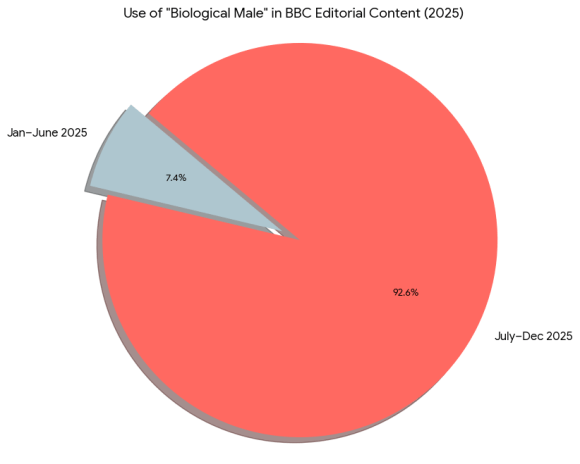
This represents a more than ten-fold/1,150% increase in the use of “biological…” language phrasing in just six months. This coincides with the intense internal pressure the BBC was facing, both internally and externally, to “balance” coverage. Sadly, by adopting language that critics see as as gender – critical framing, the human cost of using such language was often ignored.
How Amelia’s Angels researched the data
Amelia’s Angels wants to be as accurate as we can with this investigation and thought it important to share how we came to the 1,150% surge, so the data shared wasn’t just a “feeling” of bias, but because we did the work, conducting a manual audit of the BBC News archive for 2025.
We performed a site wide search (e.g., site:bbc.co.uk/news) for each instance where “biological” was used in relation to describing trans women.
We filtered out direct quotes from interviewees (unless the BBC chose to lead with it in a headline or sub – header), instead focusing on the editorial voice of the BBC – IE: the headlines and body text written by their own staff.
By checking results manually and removing duplications, we were able to see a shift:
a leap from 12 instances in the first half of 2025 to over 150 in the second.
This proves to us, that it wasn’t a subtle move into new language but one that was taken before the Style Guide was officially updated to reflect this change.
The Reactive Policy Update:
Evidence of Retroactive Alignment
To try and verify this shift, Amelia’s Angels conducted a digital inspection of the BBC News Style Guide. We used the Wayback Machine, which provides a digital archive of the internet, to compare the “Gender” entry from 15 January 2026* against the current live version (which while we can not verify the exact date this happened, Wayback Machine took it’s next screenshot on 16 February 2026), we observed a subtle but significant linguistic pivot.
Before 15 January 2026, the guide previously used a model that focused on the birth and lived – experience of those it was writing about:
“Transgender, or trans, is an umbrella term for a person whose gender identity differs from their sex recorded at birth. A person born male who lives as a female, would typically be described as a ‘transgender woman’ and would take the pronoun ‘she’.”
However, while it is important to say that while the publicly available Style Guide still centred on a respect led language model, the more than ten-fold increase in “biological” qualifiers throughout late 2025 suggests a policy practice gap and that a pivot was already underway within the newsroom. This leads us to believe (and something we will expand on in Part Two) that the Style Guide was amended to provide retrospective “top cover” for a shift in practice well underway and not to guide journalists toward better reporting.
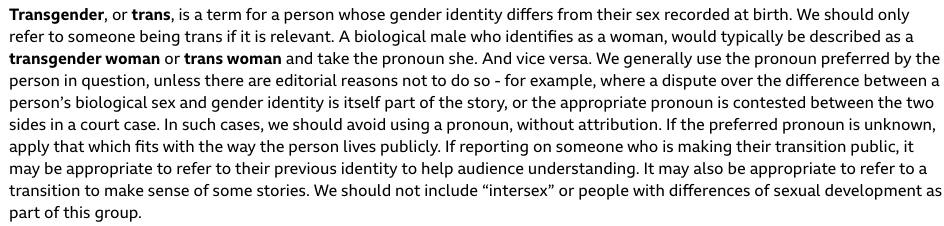
The updated entry, reflects what is now current policy, where trans related stories are led with biological essentialism and include a “loophole” for contested stories:
“Transgender, or trans, is a term for a person whose gender identity differs from their sex recorded at birth… A biological male who identifies as a woman, would typically be described as a transgender woman or trans woman and take the pronoun she… We generally use the pronoun preferred… unless there are editorial reasons not to do so—for example, where a dispute over the difference between a person’s biological sex and gender identity is itself part of the story.”
While some within the BBC believe these changes are merely “explanatory,” and won’t change the way journalists and sub – editors have always approached trans related stories, for Amelia’s Angels the timing raises questions.
The reason for our concern is in part due to massive cuts the BBC has faced in the past few years. In July 2020, the BBC axed its online editorial hub in Birmingham – a team that managed and published much of the copy written by local reporters in regional offices. This move, part of a £25 million savings plan, resulted in the loss of 33 out of 36 experienced editor roles. At the time, an insider told Press Gazette
“They have decades of experience between them…They are some of our most talented journalists….The decision to get rid of it [online editorial hub] is madness.”
In a follow – up article, an insider warned Press Gazette [see archived link] that “devolving” sub-editing to overstretched regional teams could lead to a dip in quality as they wouldn’t be “working to the same national agenda”.
Tellingly, they claimed that central newsdesk’s experienced sub-editors saved the BBC from “two or three legal cases and dozens of reputational injuries every week.”
So, while experienced journalists and sub – editors will continue to treat trans related stories with the dignity they require, the more than ten-fold increase in “biological” qualifiers suggests something else. Less experienced teams may be following an informal consensus. If one story uses a stigmatising label and it isn’t caught, it becomes the new default for others to copy.
By quietly updating the guide to include the dispute loophole immediately following a period of intense community backlash, the BBC has provided a defensible editorial framework. Complaints of bias can now be dismissed, by pointing to a policy rewritten in a way critics argue accomodates that bias. And in part this has happened because of internal system pressures, created by years of structural changes, making it easier for these new policies to take hold, despite the best efforts of those within the BBC who strive for a more inclusive standard, by describing trans people by their lived identities.
*The 15th January 2026 date is used for two reasons as our starting point. Firstly it is the day before the Hutchison v County Durham and Darlington NHS Foundation Trust case (aka “Darlington Nurses”) was ruled on by the tribunal Judge and we knew we wanted to have this as part of the investigation. Secondly, this is when we began working on this article. As more information has become available and as our own interactions with the BBC have been ongoing, it has taken a while to properly finish this piece but it also means we were able to, when doing final publication checks, assess the new information on the Style Guide change which allows us to be more accurate and up to date with our information.

The Architecture of Pressure:
FOI Silences and the Charter Renewal
The BBC has publicly pointed to “audience confusion” to justify the change in language in trans related stories, however the evidence largely remains invisible to the public. Since the April 2025 Supreme Court ruling, independent researchers and transparency advocates have submitted dozens of Freedom of Information (FOI) requests asking for data, correspondence, or the specific audience research that the BBC claims prompted the change in editorial style. However, the BBC has largely failed to honour these requests, frequently citing “journalistic derogation”. This is a kind of loophole, which provides legal exemptions allowing journalists to process or publish personal data – data that can bypass certain freedom of information requirements – without complying with the strict rules that apply to other organisations. In short, this allows them to withhold information if it relates to their output.*
However, this apparent lack of transparency, leads people to conclude the BBC may not be acting on documented audience confusion, but is instead responding to some other pressure. The BBC’s Royal Charter is up for renewal in 2027 and is currently under a two year government review. Management is operating in what could be considered a state of high – alert, exacerbated by a lawsuit on its journalistic decisions coming from the current US president. In a social, political and media climate where issues surrounding trans people are being used as a litmus test for impartiality, BBC management appears to have over – corrected, adopting the language of gender critical groups to prove they have not been “captured” by inclusive “ideologies”.
*A good summation of this can be found in an Information Commission Office (ICO) letter dated dated 29 September 2023, Reference: IC-258769-P3R0. In it, the ICO responds to after a “complainant requested information from the BBC about BBC Verify and related information.” In the FOIA decision notice they explained to the complainant why they had concluded in favour of the BBC’s derogation stance and “hence excluded from FOIA”. The decision provides an explanation to what journalistic derogation is.
Coming Sunday 15 March 2026: Knowing the data is only half the story. On Sunday we go behind the scenes of the BBC’s “Accountability Gap.” We reveal the documented paper trail of the broadcaster’s “template wall” – including the full correspondence from our co-founder, Ami – to show how the national broadcaster used a reactive policy update to justify silencing the community it claims to serve.
If you like this post, please subscribe/share/like
Share ‘Beyond the Headlines – Part One: Examining the BBC’s Measurable Rise In The Use Of ‘Biological’ qualifiers’ with others
Everything we do: life coaching, support, advocacy etc, is offered free. A few kind people have asked how they can support us; so this is a way to do that if you’d like to. What we’re building here will need funding down the line. We’re immensely grateful for your support. Ami & Dillon.
Help Ami get urgent revision surgery after complications
GoFundMe Fundraiser:
Discover more from Amelia's Angels
Subscribe to get the latest posts sent to your email.

